

This portfolio presents a selection of my technical writing and information design deliverables, illustrating the breadth and impact of my contributions across healthcare, education, and business sectors. Each section highlights representative work — from standards-based documentation and compliance reporting to branded communication tools and user-focused training materials — with outcomes that demonstrate improved clarity, consistency, and organizational effectiveness.
As part of J P Systems’ Clinical Data Quality (CDQ) team supporting the Veterans Health Information Exchange (VHIE), I provided technical writing, project facilitation, and strategic communications that advanced VA interoperability and clinical data quality initiatives. My work combined content governance, plain-language technical documentation, and stakeholder engagement to support compliance, knowledge transfer, and program visibility. Highlights include:
Process Documentation – Led the creation of 50+ standardized process documents aligned with ISO 9001:2015 and CMMI Level 2, ensuring audit readiness, operational transparency, and knowledge retention.
Knowledge Resources – Authored the CDQ Team Desk Guide, a centralized reference that improved onboarding, reduced knowledge gaps, and supported day-to-day continuity across the team.
Technical & Standards Documentation – Produced HL7® FHIR® Implementation Guide content, use cases, and acceptance criteria, translating interoperability requirements into actionable documentation for federal pilots with VA and FDA.
Collaboration Tools – Designed and developed a SharePoint/Power App solution with automated workflows accessible on GFE devices, saving 20+ hours per week in tracking and reporting while providing leadership with real-time oversight.
Stakeholder Reporting – Coordinated and authored CDQ annual reports, executive presentations, and monthly deliverable updates, ensuring accuracy, clarity, and alignment with VHIE strategic goals.
Templates & Branding – Created 508-compliant, VA-branded artifact templates adopted across CDQ deliverables, ensuring consistency, clarity, and adherence to VA standards.
External Communications – Served as lead author on proposals, white papers, and conference artifacts (e.g., AMIA, HIMSS, ANIA), amplifying CDQ program visibility at national forums.
Impact: These efforts strengthened CDQ’s operational effectiveness, improved federal health data exchange initiatives, and positioned J P Systems as a trusted partner to VA in advancing clinical data quality and interoperability.
As part of the technical writing team, I led initiatives to unify authoring tools, standardize documentation, and strengthen brand consistency across SaaS products. My work focused on creating accessible, structured documentation that improved both internal efficiency and customer experience. Highlights include:
Tool Evaluation & Migration – Assessed industry-leading authoring tools and recommended adoption of MadCap Flare for XML/CSS-driven structured authoring.
Branded Templates – Designed a standardized MadCap Flare template that unified layout, styling, and navigation across product documentation, ensuring consistency and accessibility.
Documentation Governance – Authored content frameworks and guidelines that established 508-compliance standards and supported ISO 9001 documentation practices.
Change Management – Developed a phased migration and onboarding plan for distributed teams, improving adoption of new authoring practices.
Impact: These efforts streamlined authoring workflows, produced consistent branded deliverables, and directly contributed to measurable improvements in user satisfaction. RelayHealth’s KLAS training scores increased from 6.0 to 8.2 within six months, while branded templates strengthened product identity and customer trust.
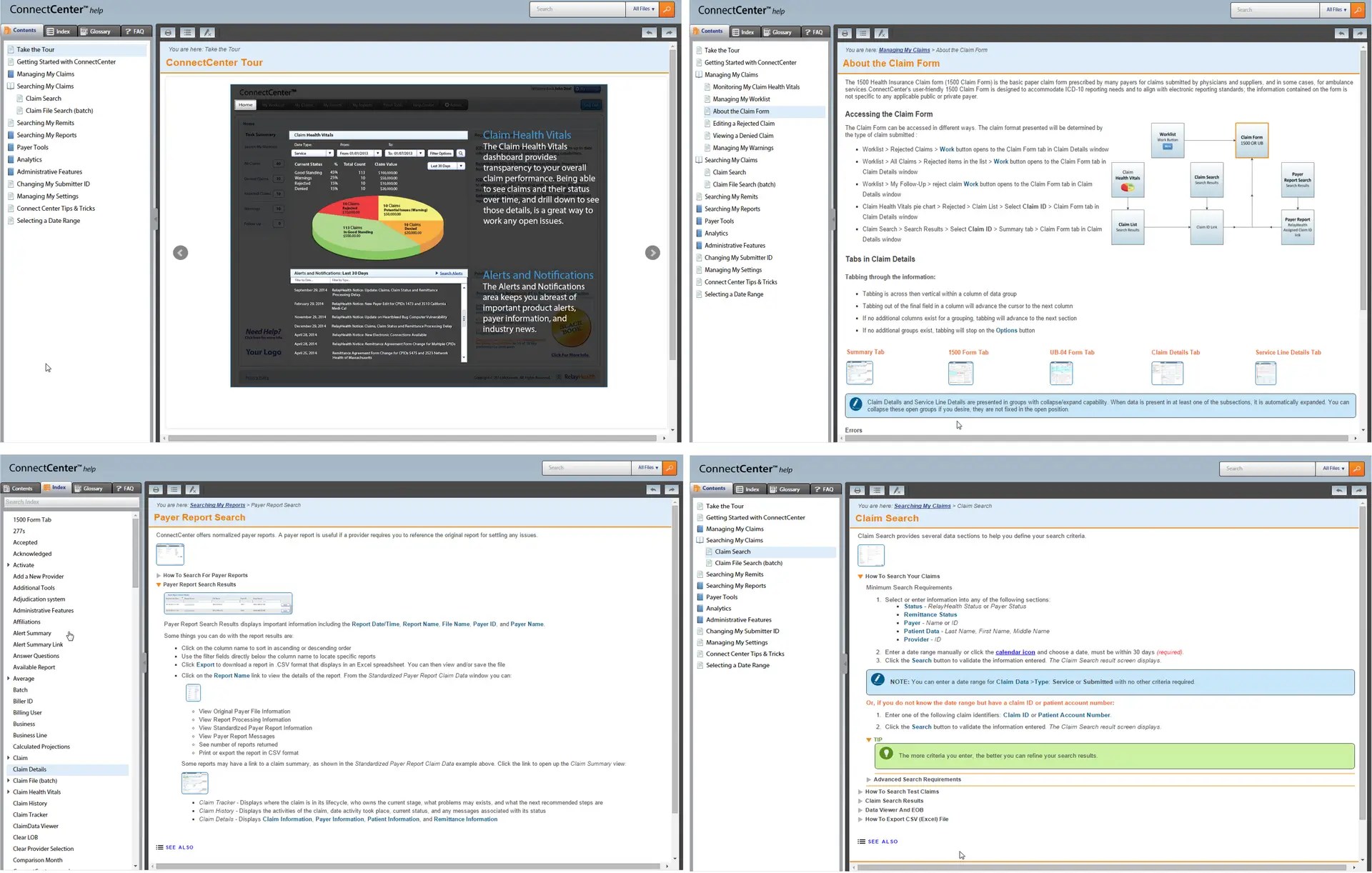
RelayHealth ConnectCenter Help System
Developed the HTML5 help system for RelayHealth’s ConnectCenter, a SaaS revenue cycle management portal designed to simplify claim submission, eligibility verification, and payer reporting for physician practices and billing partners. Using MadCap Flare (XML-based authoring), I created structured, searchable content that supported end users with clear task-based guidance. To improve comprehension, I integrated custom diagrams and icons designed in Adobe Illustrator and workflow captures created with MadCap Capture.
The help system guided users through new eligibility verification capabilities—including confirming patient insurance, validating deductibles and co-pays, and resolving payer denials across 1,200+ connected payer portals. By transforming complex processes into accessible documentation, I enabled practices and revenue cycle partners to reduce claim rejections, accelerate collections, and improve overall system adoption.

Financial Insight 2.0 Quick Start Guide
Authored the Quick Start Guide for RelayHealth’s Financial Insight v2.0, a revenue cycle management service delivering daily claims data for analytics. This concise, three-page guide distilled complex onboarding steps into an accessible reference for new clients, covering setup prerequisites, data-use agreements, provider rosters, file formats, and retrieval processes.
Using clear diagrams, naming conventions, and annotated examples, the guide provided an “at-a-glance” resource to help technical and business users quickly establish connections and begin receiving data feeds. Designed for efficiency, it reduced reliance on support staff during implementations and improved client adoption rates.

Financial Insight User Guide
Created the guide (27 pages) to provide developers and technical teams with comprehensive instructions for integrating with RelayHealth’s daily claims data service. This in-depth guide documented SOAP web service operations, request/response formats, filtering options, security requirements, SFTP connectivity, file naming conventions, and compression standards.
To support real-world use, it included XML and CSV code samples, manifest file validation details, and visual file-flow representations. By combining detailed technical references with structured navigation, the guide empowered developers to build and troubleshoot integrations independently, ensuring interoperability and data accuracy across multiple payer systems.

3 Amigos Quick Reference Card
As part of RelayHealth’s transition from a waterfall model to an Agile framework, I authored the Software Creation Handbook and developed this companion quick reference card. The card distilled Agile best practices into an at-a-glance guide for team members, ensuring consistent understanding of the 3 Amigos process, where a Business Analyst/SME, Developer, and Quality Analyst/Tester collaborate to define, build, and validate user stories until they are truly “Done.”
Created using Microsoft Word and Visio, it paired process clarity with visual structure, making it easy to use during daily standups or iteration planning. Together with the handbook, this deliverable supported cultural change, improved alignment across functions, and gave RelayHealth teams a scalable foundation for Agile adoption.
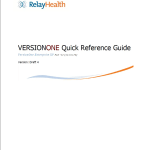
VersionOne Quick Reference Guide
Authored this Quick Reference Guide to support RelayHealth teams in adopting VersionOne, an Agile lifecycle management tool. The guide distilled complex Agile workflows into an accessible format that reinforced the organization’s new Software Creation Process.
The deliverable provided:
Step-by-step guidance on themes, epics, stories, defects, and backlog management.
Standardized attributes for stories and defects, ensuring consistency in prioritization, estimation, and status tracking across projects.
Best practices and status flow diagrams to help distributed teams align on iteration planning, daily stand-ups, and retrospectives.
Responsibilities mapping for roles such as Product Owner, Scrum Master, and Scrum Team, clarifying ownership of Agile activities.
Developed in Microsoft Word and Visio, the guide functioned as both a training resource and an operational reference. By codifying workflows and providing quick-access visuals, it improved consistency, reduced onboarding time, and strengthened alignment across development, QA, and business teams.
As an independent Information Designer, I provided writing and design services for clients in higher education, healthcare, nonprofit, and small business sectors. My work ranged from compliance manuals and academic course materials to marketing collateral, logos, and full visual identities. Each engagement combined clear communication with strong visual design to improve user experience, brand recognition, and message consistency. Highlights include:
eLearning Workbook Development – Designed and authored the Keys to the Boardroom participant workbook (100+ pages) for the Director Institute, complementing a 10-part eLearning video series with structured modules, visual aids, and interactive exercises.
Compliance & Academic Materials – Produced course materials, compliance manuals, and policy documentation tailored to regulated industries and higher education programs.
Visual Communication Design – Created branded collateral, logos, and identity systems that strengthened client messaging and professional presence.
Information Design – Applied principles of clarity, hierarchy, and accessibility to deliver content that engaged diverse audiences and improved usability.
Impact: These projects enhanced client credibility and professional presence, supported compliance and audit readiness, and improved learner engagement through accessible design. Clients reported increased recognition of their programs and greater value from educational resources.

Director Institute – Keys to the Boardroom eLearning Workbook
For this professional development program, I applied information design principles to create a 100+ page participant workbook that complemented a 10-part eLearning video series. The workbook guided learners through structured modules with:
Visual learning aids such as iconography and layouts that simplified complex leadership concepts.
Interactive elements including self-assessments, portfolio mapping, and reflection prompts that encouraged learner participation.
Progressive flow that built from foundational topics (board role myths, leadership presence) to advanced strategy (expanding board portfolios, crafting a director brand).
This design approach ensured executives could easily navigate the material, apply insights in practice, and transition into board leadership roles with confidence.
At GPC, I combined technical writing, business analysis, project coordination, and information design to support mission-critical projects for the Office of Information Technology (OIT) and Client Relations and Customer Services (CRS). In the Office of Institutional Advancement, I produced branded presentations, donor communications, and reports that strengthened community engagement and supported the college’s strategic initiatives. Highlights include:
Communication & Marketing Plans – Authored strategic communication and marketing plans, including an OIT communication plan and SharePoint marketing/communications plan, to improve engagement and alignment across the college.
Web Content Strategy – Led content strategy and redesign for the OIT website, delivering clear, user-centered information that improved navigation, strengthened visibility of IT services, and increased stakeholder engagement.
Governance & Process Documentation – Created an OIT escalation process plan/SLA, OIT style guide, and Jag-list end-user documentation, ensuring consistency, accountability, and ease of use.
Technical Documentation – Authored SharePoint quick start guides, developer documentation, and reference materials to support adoption and provide accessible resources for faculty and staff.
Organizational Reporting – Produced the OIT newsletter and the OIT annual report, fostering transparency, accountability, and continuous improvement.
Institutional Advancement Communications – Designed branded donor presentations and produced community engagement reports to support fundraising and strengthen relationships with external stakeholders.
Impact: Through these initiatives, I delivered documentation and communication strategies that supported collaboration, improved clarity of IT services, enhanced student and faculty access to resources, and advanced the college’s outreach to its community.